Images and Video
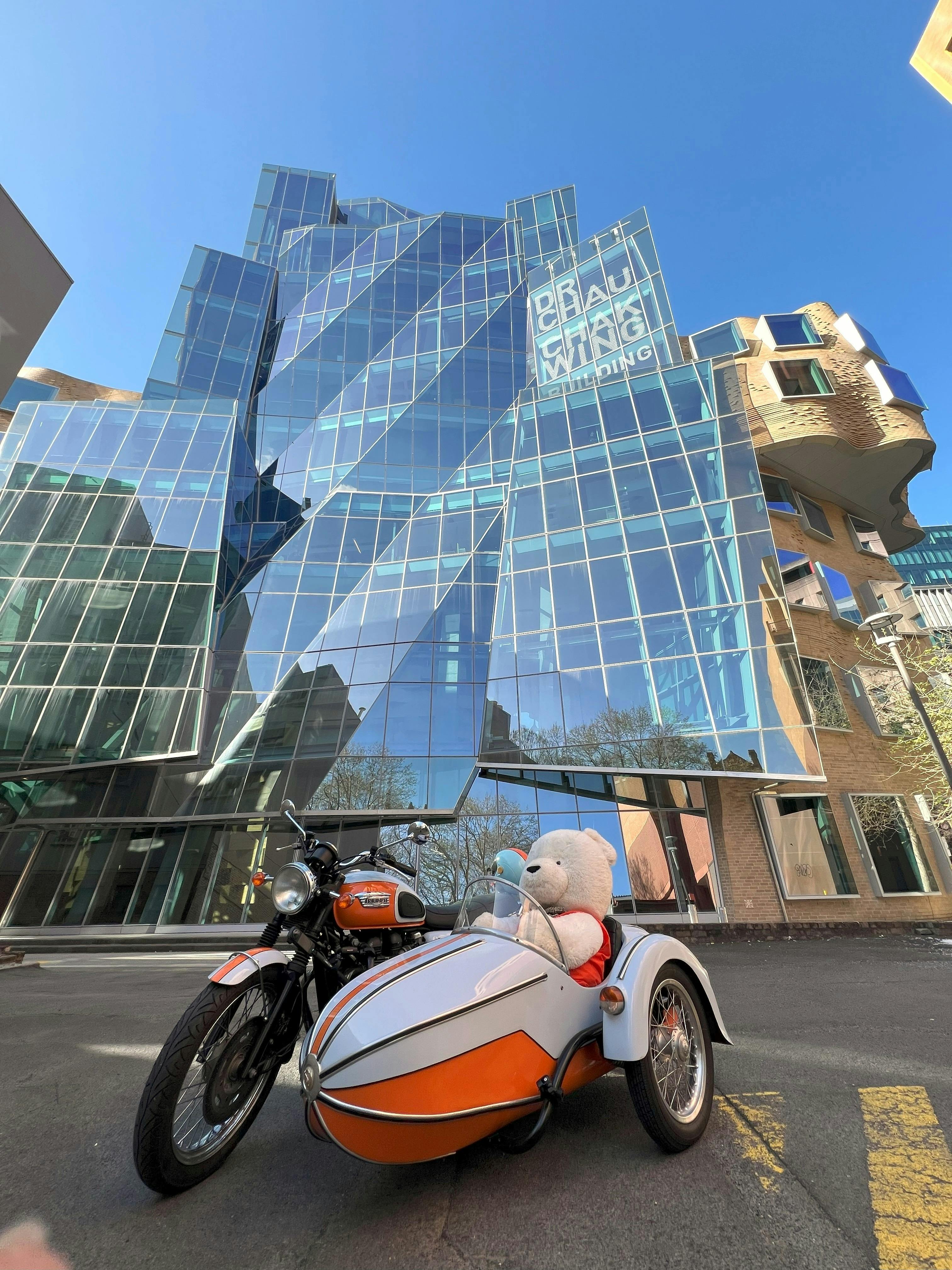

Sydney Architecture
Highlights
- Explore Sydney's architectural gems, from Francis Greenway's historic designs to Frank Gehry's modern masterpieces.
- Discover the elegant charm of the Mint and the futuristic curves of Barangaroo House in one tour.
- Uncover the stories behind Sydney's evolution and creativity through its stunning buildings and structures.
- Enjoy a customised half-day tour that highlights the city's unique architectural landscape and rich history.
The harbour city is famous for its natural beauty, now ride with us to discover the beauty of its buildings. You’ll be introduced to the city’s finest structures, from the city-shaping vision of convict architect Francis Greenway to the wild imagination of Frank Gehry; from the elegant period charm of the Mint to the futuristic curves of Barangaroo House. Hear the stories of Sydney through its architecture: a story of evolution, creativity, and vision.
Itinerary highlights
Readers Digest Building
Opened in 1967, this low-rise building showcases the combined expertise of architect John James, designer and sculptor Douglas Annand and landscape architect Bruce Mackenzie. John James said the building was constructed of “machine age” components but they made every effort to avoid the “cold and sterile box and to create a warm, friendly place for people to work in”. Or at least, by the standards of the 1960s! When it opened it was decorated with cast iron sculptures, which–even though they’re pretty abstract–were too scandalous for the time, and most were quickly removed. It also has one of Australia’s first rooftop courtyard gardens, but we won’t be able to see that from the street.
Between September 1994 and September 1995 the building was refurbished to the design of Perumal Partners Architects, which worked in consultation with John James. In 2016 it won the National Award for Enduring Architecture.
Aurora Place
Designed by Renzo Piano, the 41-storey building is 188 m (617 ft) tall to the roof, and 218 m (715 ft) to the top of the spire. Not one panel is parallel to any grid. The east façade bulges out slightly from its base, reaching its maximum width at the top floors. The curved and twisted shape of east façade was designed to share the mood of the Sydney Opera House like sails on the harbour. The exterior glass curtain-wall extends beyond the main building, creating an illusion of its independence.
Aurora Place won the 2002 Property Council of Australia Rider Hunt Award, handled out for technical and financial qualities. On 2 June 2009, French urban climber Alain Robert scaled this building in protest against climate change.
Sydney Opera House
Conceptual sketches were enough for Jorn Utzon to win the design competition in 1957 to build on Sydney’s best site – previously occupied by a tram depot! By 1958 the tramsheds were gone and construction began in 1959 – before the design was complete. By the start of 1961 work was running almost a year behind schedule. After long and storied construction process it was finally opened in 1973. Our Sydney Opera House has won architecture awards in the 1970s, 1980s, 1990s, 2000s, and 2020s.
Hyde Park Barracks
Designed by convict architect Francis Greenway, these barracks were completed in June 1819. Macquarie was so impressed by Greenway’s design that he gave him a full pardon.
Macquarie noted that since opening, “not a tenth part of the former Night Robberies and Burglaries” occurred. But others complained that collecting “depraved and desperate characters” in one area had just condensed the problem. Originally designed for 600 men, up to 1400 men were housed in the Barracks at any one time. Around 30,000 men and boys passed through the Barracks between 1819 and 1848.
Convict transportation ended in 1840, and in 1848 the Barracks became the Female Immigration Depot, the Orphan Institution until 1852, and the Asylum for Infirm and Destitute Women between 1862 and 1886. In 1886 the women were moved out and the courts expanded into the site.
Conservation works in the 1980s unearthed about 100,000 artifacts preserved for over 150 years under the floorboards. Since the restoration the Barracks have been open to the public as a museum. The clock is the oldest public clock in Australia, and still wound by hand every week.
In 2010 the site was inscribed on the UNESCO World Heritage List.
St Mary's Cathedral
In 1820 Father John Therry arrived in Sydney to officially minister to the Roman Catholics in Sydney. The day he arrived, he had a vision of a mighty church of golden stone dedicated to the Blessed Virgin Mary raising its twin spires above the city of Sydney. And 180 years later, it came to pass.
The first archbishop of the Roman Catholic Church in Australia, John Polding, laid the foundation stone for the cathedral in 1868. Although the dedication Mass was held in 1882, the nave was only finished in 1928, the crypt in 1961, and the spires in 2000.
St Mary’s Cathedral is oriented in a north–south direction rather than the usual east–west. The liturgical East End is at the north and the West Front is to the south. The entrance façade is loosely based on Notre Dame in Paris.
It was listed on the state Heritage register in 2004.
State Library – Mitchell Wing
The Mitchell Wing of the State Library of NSW was designed by Walter Liberty Vernon and completed in 1910. It is the oldest public library in Australia. It was added to the New South Wales State Heritage Register in 1999. The 1926 statue of William Shakespeare out front was moved in 1959 to make room for Cahill Expressway traffic. Luckily there are plans afoot to relocate it somewhere more sensible.
Chief Secretary's Building
Built in the 1870s for the Colonial Secretary (later known as the Chief Secretary), who was the most important government official in NSW in the 19th century, responsible for the administration of the colony. The elevated site and its monumental scale reflects this important status.
The first stage was built between 1873 and 1881, by Colonial Architect James Barnet. It was extended in the 1890s to fit the growing number of staff of the Department, and the Department of Public Works. Sir Henry Parkes, 5 times NSW Premier and Colonial Secretary, played an important role in the design of the building. In 1877 he commissioned Italian-born sculptor Achille Simonetti to carve 6 allegorical figures for the niches on the corner facades of the building. They depict Justice, Wisdom, Mercy, Science, Labour, and Art.
Crown Tower
Crown Sydney was designed by WilkinsonEyre. It was completed in 2020 and includes a hotel, casino, restaurants and bars and residential apartments. It is 273m tall with 75 floors. The casino was very controversial, since by the time the building was ready to open in December 2020, Crown Resorts had admitted to money laundering and was banned from operating. After a corporate takeover and a complete renewal of the board and management, the casino finally opened in August 2022.
The tower sits on the site of former industrial wharves. The design of the tower is based on three “petals” that twist 60 degrees along the height of the building. In 2021 It was the first Australian building to win the Emporis Skyscaper Award.
Chau Chak Wing building
This is the first building in Australia designed by Canadian American architect Frank Gehry. Its named after a Chinese businessman who donated $20 million for the building’s construction, and his honorary doctorate.
The building’s design is based on the idea of a tree-house structure. The western facade is all angled glass shards, and the northern, eastern, and southern sides are made of 320,000 custom-designed bricks and give it the look of a crumpled paper bag. Frank Gehry said, “Maybe it’s a brown paper bag, but it’s flexible on the inside, there’s a lot of room for changes or movement.”
The 13-storey tower provides teaching, learning, research and office accommodation for approximately 1,256 students and 326 academic staff.
Tour details
Features
Service facilities
Disabled access available, contact operator for details.
Operation information
Sidecar Hustle
At Sidecar Hustle, there’s no cookie-cutter sightseeing like every other tour company. They only offer premium, private sidecar tours of Sydney that are as unique as the city itself—fun, informative, and customised just for you.
Ride in style in a beautiful classic sidecar as you discover Sydney with passionate, professional local guides. Whether it’s your first visit or your fiftieth, you’ll see a side of the city that’s usually reserved for friends, not tourists.
Your guide will be a professional storyteller, not just a driver; a Sydneysider through and through, with years of experience and an eye for detail. You’ll get the real stories, the hidden gems, and the local secrets most people miss.
Plan more around this area
 Surry Hills, NSW
 202 Elizabeth
A hidden boutique hotel on Elizabeth Street, where luxury meets exclusivity — a captivating refuge where sophistication meets tranquillity.

 Haymarket, NSW
YHA Sydney Central
Sydney Central YHA is backpacker accommodation at its finest, with a rooftop swimming pool, sauna and a sunny outdoor area with panoramic views.

 Surry Hills, NSW
 Little Drifter Surry Hills Hostel Hotel
Welcome to The Village Hostel Surry Hills, where the thrills of Sydney meet the comfort of home. Right in the midst of this eclectic suburb.
 Sydney, NSW
Mercure Sydney
With stylish, modern accommodation, personalised services and a convenient location, Mercure Sydney is among the leading hotels for business and holiday travel.
 Surry Hills, NSW
 Paramount House Hotel
Paramount House Hotel is located in the former headquarters of Paramount Picture Studios in Surry Hills, Sydney. Our 29 rooms are a mix of heritage
 Sydney, NSW
 Central Studio Hotel Sydney
Central Studio Hotel Sydney is ideally located opposite Central Station, in the heart of Sydney.
 Surry Hills, NSW
 El Loco Surry Hills
El Loco is lively, loud and proud of it. They speak fluent tequila (with more than 25 types on offer) and they’re crazy for tacos;
 Surry Hills, NSW
 Yulli’s
At Yulli’s Bar and Restaurant, they’re passionate about making tasty vegan and gluten-free food and combining it with the best beer and wine NSW has
 Surry Hills, NSW
 Forrester's Sydney
A community hub for connection and celebration, Forrester’s is a historic tavern where people have been drinking, eating and gathering for over 100 years.
 Surry Hills, NSW
 Mille Vini Pasta & Wine Bar
Offering a classic trattoria experience on Crown Street – aka Surry Hills’ popular eat street – Mille Vini (which means “a thousand wines” in Italian)
 Surry Hills, NSW
 Nour
Dishing up Lebanese fare since 2016, Nour has become a staple on Sydney’s foodie scene.
 Surry Hills, NSW
 Refettorio OzHarvest Sydney
Refettorio OzHarvest Sydney is an Australian-first, social impact collaboration between OzHarvest and Massimo Bottura's Food for Soul.
